
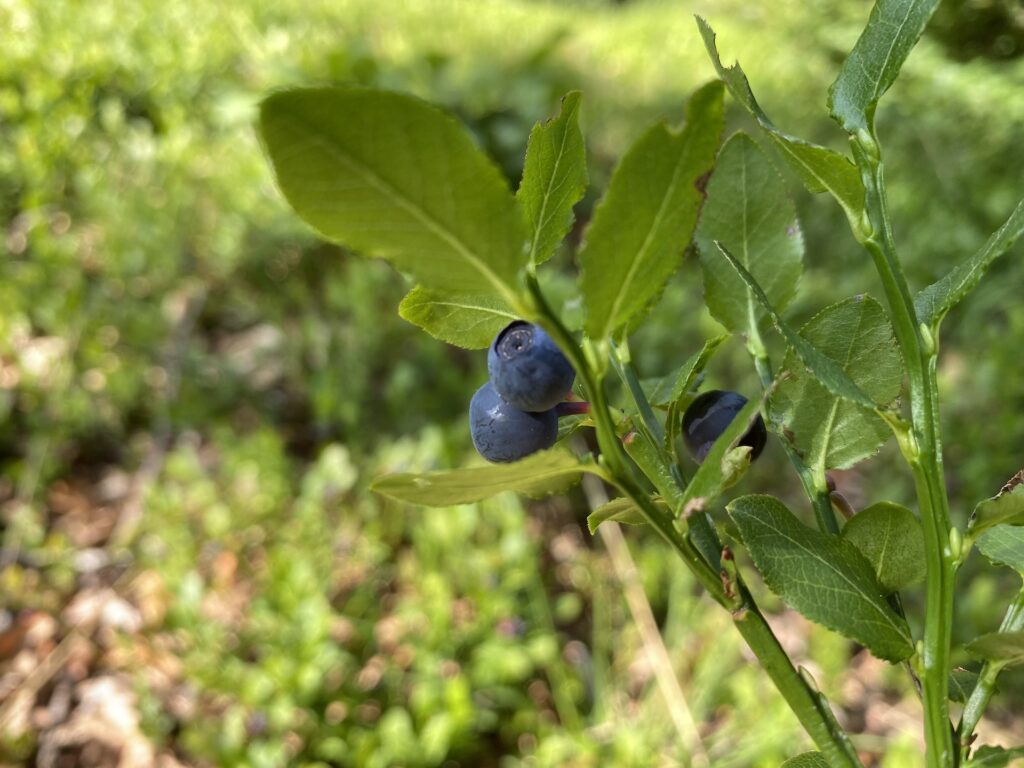
Bilberry extracts (Vaccinium myrtillus L.) have been among the most widely used and appreciated botanical ingredients in food supplements worldwide for decades.
Unlike commonly cultivated blueberries, which mainly belong to species such as Vaccinium corymbosum L. and Vaccinium angustifolium Aiton, bilberry (Vaccinium myrtillus L.) used for the production of high-quality extracts grows exclusively in the wild, naturally thriving in forest undergrowth. The berries are harvested only when fully ripe, either by hand or with the aid of small berry rakes.
Once harvested in the forests, Vaccinium myrtillus L. berries are quickly transferred to processing facilities, where they are promptly frozen in order to preserve their natural characteristics as effectively as possible and minimize oxidative degradation.
Because the raw material is entirely wild-harvested, bilberry availability is particularly sensitive to climatic conditions, harvesting labour and, naturally, the balance between international supply and demand.
A raw material highly dependent on the harvest season
The 2025 harvest campaign was the most difficult ever experienced by the European wild bilberry market: a true annus horribilis for the industry.
In the main harvesting areas of Central and Eastern Europe, particularly in the Carpathian region, unfavourable weather conditions during the critical development and flowering stages severely affected berry availability.
Vaccinium myrtillus is particularly vulnerable to late frosts. Sub-zero temperatures during bud development and flowering can damage reproductive tissues and directly compromise subsequent fruit production.
As a result, the 2025 harvest led to exceptionally limited raw material availability and a sharp increase in berry prices, which inevitably translated into higher extract costs.
Expectations for the 2026 campaign were therefore particularly high.
In the Carpathians, production did in fact improve significantly, with berry availability considerably higher than in the previous year.
Under normal market conditions, a harvest of this magnitude would have been expected to trigger a gradual correction in prices.
This, however, did not happen.
International demand remained exceptionally strong, also because the extremely difficult previous campaign had effectively depleted inventories throughout the supply chain.
During 2025, due to the severe shortage of raw material and exceptionally high prices, many operators purchased berries only against confirmed customer orders, avoiding the rebuilding of stocks.
With the start of the 2026 campaign, a substantial part of the increased availability was therefore absorbed not only by current demand, but also by the need to rebuild inventories that had been virtually exhausted.
This strong absorption prevented the improved harvest from generating the downward pressure on prices that many market participants had expected.
The situation in the Nordic countries, traditionally important sourcing regions for wild bilberries, further complicated the market.
In Finland in particular, the main constraint in 2026 was not the availability of berries in the forests, but the availability of people to harvest them.
The Finnish wild berry sector has historically relied heavily on foreign seasonal workers, particularly from Thailand.
Stricter seasonal labour rules and increased controls following problems identified in previous years substantially reduced the number of pickers available for the 2026 season.
The result was an almost paradoxical situation: even where berries were available in the forests, a significant proportion of the crop remained unharvested because of insufficient labour.
The combination of these factors — good production in the Carpathians absorbed by exceptionally strong demand, together with operational harvesting constraints in the Nordic region — meant that the 2026 campaign closed very differently from what had initially been hoped.
Wild bilberry prices have remained exceptionally high, broadly in line with the record levels seen during the 2025 harvest, rather than easing as many in the market had expected at the start of the season. In some sourcing regions, prices have climbed even further, surpassing last year’s peaks and setting new records.
In market conditions such as these, characterised by scarce and particularly expensive raw material, it becomes even more important to pay close attention to the risk of adulteration and, above all, to understand exactly what is being purchased.
This is by no means a purely theoretical risk: a study published in 2026, based on HPLC-DAD fingerprinting of commercially available anthocyanin-containing products, identified significant authenticity concerns, with only 54% of the products analysed being verified as authentic.
When berry prices rise so significantly, economic pressure inevitably increases throughout the supply chain.
It therefore becomes essential to assess not only the declared standardisation of an extract, but also its authenticity, its actual content of active constituents and the analytical method used to determine it.
This is where one of the most frequently overlooked aspects of Vaccinium myrtillus extracts becomes particularly relevant: a percentage value on its own does not necessarily provide enough information.
An extract declared as 25%, for example, is not necessarily equivalent to another extract also declared as 25%.
The key question therefore becomes: What does it actually mean to say that a bilberry extract contains 25% anthocyanins?
What are the active compounds in bilberry?
Bilberry fruits (Vaccinium myrtillus L.) are one of the richest natural sources of anthocyanins.
These polyphenolic compounds give bilberries their characteristic deep blue-black colour, which is present not only in the skin but also in the flesh.
This makes European bilberry easy to distinguish from many cultivated blueberry varieties, which typically have pale-coloured flesh.
Anthocyanins are regarded as the main bioactive compounds responsible for many of the health benefits associated with bilberry and other berries.
When evaluating a bilberry extract, anthocyanin concentration is therefore a key parameter.
However, another equally important factor should not be overlooked: the daily dose at which the product is intended to be used.
A higher anthocyanin concentration indicates a more concentrated extract and requires a greater quantity of fresh berries, with a corresponding increase in production costs.
But concentration is not the only parameter that matters.
Vaccinium myrtillus has a characteristic profile consisting of 15 main anthocyanins, derived from combinations of five anthocyanidins — mainly delphinidin, cyanidin, petunidin, peonidin and malvidin — with different sugars.
Their presence and relative proportions form what is commonly referred to as the anthocyanin fingerprint of bilberry.
This fingerprint acts as a true analytical signature, helping to confirm the authenticity of the extract and distinguish it from other anthocyanin-containing berry sources.
How are anthocyanins measured? UV or HPLC?
Several analytical methods can be used to quantify anthocyanins.
The two most commonly used are:
UV-Vis spectrophotometry: a historical and relatively simple method that was also used for many years for pharmaceutical release testing;
HPLC (High-Performance Liquid Chromatography): a more precise and selective method, now recognised by both the European Pharmacopoeia (Ph. Eur.) and the United States Pharmacopeia (USP).
The “magic” 25% and the actual content
For many years, bilberry extracts were standardised using the UV method, which indirectly quantifies anthocyanin content through the measurement of total anthocyanidins.
Using this method, extracts were standardised and released at 25% anthocyanidins.
Over time, this value became a historical benchmark and a recognised gold standard for identifying an authentic, high-quality bilberry extract.
However, the enormous commercial success of these products in the food supplement market also encouraged economically motivated adulteration.
This was often achieved through the addition of undeclared anthocyanin-containing colourants capable of interfering with the UV method.
The UV method is based on measuring absorbance at a wavelength characteristic of anthocyanidins.
It therefore provides an indirect estimate of total content, but it cannot distinguish between different molecules absorbing at the same wavelength.
As a result, it cannot determine which individual anthocyanidin is present — for example cyanidin, delphinidin or malvidin — nor whether the molecule is present in free form or bound to sugars as an anthocyanin.
In addition, any substance with similar absorbance around 520 nm may contribute to the overall signal.
To address this type of fraud, HPLC, initially used mainly for finished-product release testing, was progressively adopted for raw material validation as well.
Thanks to its ability to separate and identify individual anthocyanins, HPLC makes it possible to distinguish an authentic profile — the true bilberry fingerprint — from an adulterated one.
This makes fraudulent additions much more difficult to conceal.
This analytical approach was subsequently officially recognised by both the European Pharmacopoeia and the United States Pharmacopeia.
With the transition to HPLC, it became clear that a genuine wild bilberry extract (Vaccinium myrtillus L.) showing 25% anthocyanidins by the UV method contains approximately 36% anthocyanins when analysed using the corresponding HPLC method.
This difference does not mean that the extract suddenly contains more active constituents.
It reflects the fact that the two analytical methods determine and express the content according to different analytical principles.
HPLC directly measures the individual anthocyanins in their glycosylated form — the natural form present in fresh berries — whereas the UV method indirectly quantifies total anthocyanidins.
Why the analytical method matters
When discussing a bilberry extract and referring to the well-known 25%, it is essential to specify which analytical method was used.
Two authentic wild bilberry extracts (Vaccinium myrtillus L.), both declared as 25%, may contain very different amounts of active constituents depending on whether the result was obtained by UV or HPLC.
As explained above, a reference extract standardised to 25% by UV corresponds to approximately 36% by HPLC.
Conversely, a product declared as 25% by HPLC corresponds to approximately 18% by UV and therefore contains around 30% less anthocyanins than the former.
As a consequence, an extract standardised to 25% HPLC should be proportionally less expensive.
To provide the same amount of active constituents as a 25% UV / 36% HPLC extract, it must also be used at a higher dose.
In practical terms, 100 mg of a 36% HPLC extract provides approximately 36 mg of anthocyanins, whereas 100 mg of a 25% HPLC extract provides approximately 25 mg.
To deliver around 36 mg of anthocyanins using a 25% HPLC extract, approximately 144 mg of product would therefore be required.
For this reason, when comparing two bilberry extracts commercially, the price per kilogram alone is not sufficient.
What really matters is the cost in relation to the actual amount of anthocyanins delivered in the final formulation.
Conclusion
To ensure quality, efficacy and transparency, it is essential to assess not only the declared standardisation of bilberry extracts, but also the analytical method used.
Only by doing so is it possible to compare products correctly and avoid misleading interpretations.
Terminology note – Anthocyanins and anthocyanidins: what is the difference?
To avoid misunderstandings, the main terms used in this article are clarified below.
Anthocyanins are water-soluble pigments belonging to the flavonoid family.
They occur naturally in plants in their glycosylated form, meaning that they are bound to sugar molecules.
They are responsible for the characteristic blue-purple colour of fruits such as bilberry and represent the form naturally present in fresh berries.
Anthocyanidins are the sugar-free forms of anthocyanins, also known as aglycones.
They are obtained by breaking the bond between the anthocyanin and its sugar moiety through a process known as hydrolysis.
In summary:
Anthocyanins are the naturally occurring compounds present in the berries and are generally quantified using HPLC methods.
Anthocyanidins are their sugar-free forms and are generally quantified using spectrophotometric analytical methods.